 Marriage Point Calc
How to play Nepali Marriage
- Deal 21 cards each. Shuffle three standard decks for a typical two- to five-player table. Keep the undealt cards face down as the stock and turn one up to start the discard pile.
- Take one card and discard one. Draw from the stock or take the most recent discard. If you pick up that discard, keep it for this turn and throw a different card. If the stock runs out, shuffle the older discards into a new stock and leave the top discard in place.
- Show your qualifying combinations. Lay down three pure sequences or tunnelas in any mix. The first player to qualify establishes the hidden Tiplu. Later players may look once they qualify. Tables that allow the Dublee route usually let a player see the Tiplu with seven matching pairs.
- Finish after a draw. In the usual route, use your remaining 12 cards in four valid groups and discard the extra card. If you took the Dublee route, finish with an eighth matching pair.
Which card combinations count?
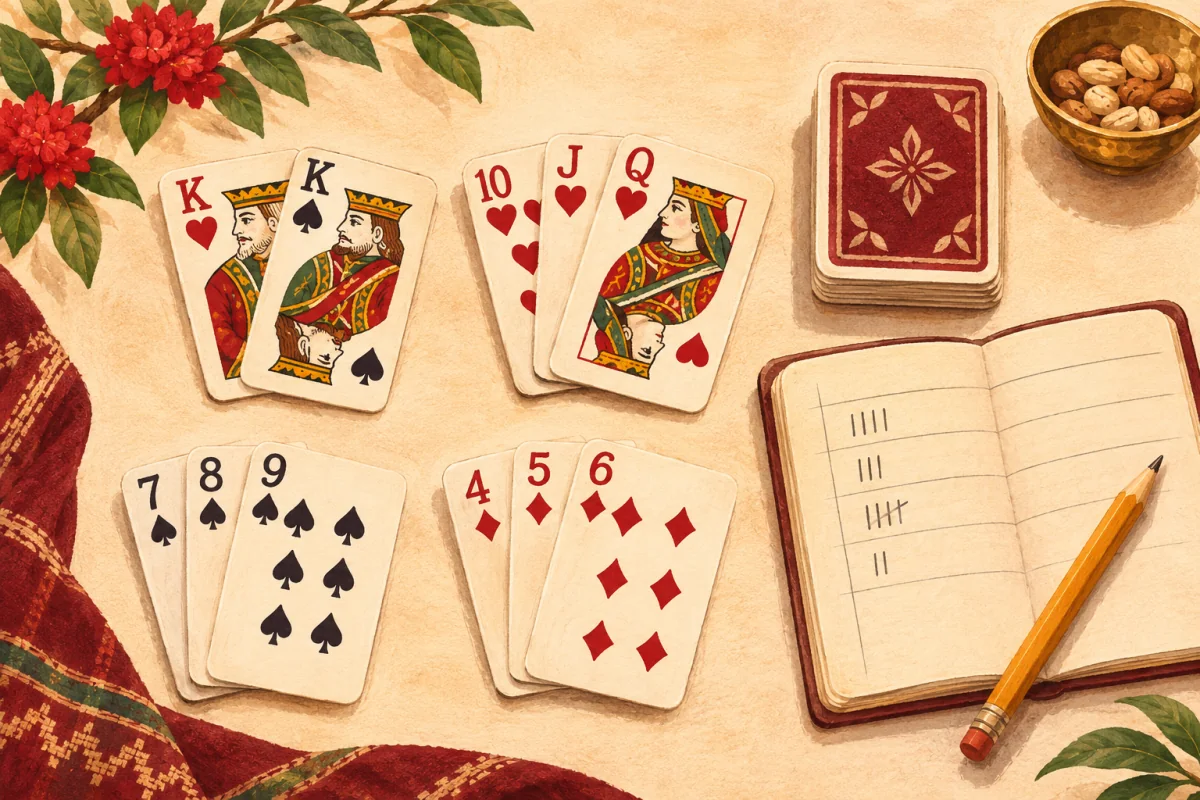
- Pure sequence. Consecutive cards of one suit, such as 4, 5, and 6 of clubs. An ace can sit at either end of a run, as in ace–2–3 or queen–king–ace.
- Tunnela. Three copies of the same rank and suit, such as three 9s of hearts. Agree whether the scoring bonus requires showing the three cards immediately after the deal.
- Trial. Cards of the same rank in different suits, such as a 10 of clubs, a 10 of diamonds, and a 10 of spades. Save trials for the finishing stage.
- Dublee. Two copies of the same rank and suit. Two queens of spades make a Dublee.
After you see the Tiplu, a wild card can fill a gap in a run or help complete a trial. A Dublee or tunnela requires matching copies.
Which cards are Maal?
If the hidden Tiplu is the 6 of hearts, the other 6s of hearts are Tiplu cards. The 5 of hearts is the Jhiplu and the 7 of hearts is the Poplu. A hand holding one of each has a Marriage. These cards may score as a combination under your table’s Maal values.
Other 6s can work as wild cards. Some tables also award points for the same rank in the other suit of the same color, called the Alter. In this example that’s the 6 of diamonds. If you play with printed Man or Superman cards, agree when they turn wild and how much they score. Dashain’s version allows the optional Superman to act as a wild card before a player sees the Tiplu. Dashain’s Marriage rules.
How to calculate Marriage points
Record who finished, who saw the Tiplu, and how much Maal each player held. Settle differences in counted Maal among the players, then apply the finishing points and any Dublee or Foul adjustments. A common setup awards the finisher 3 points from each seen opponent and 10 from each unseen opponent. Check your table’s values before you deal.
Murder and Kidnap scoring
Murder discards an unseen player’s Maal from the count. Kidnap credits that Maal to the finisher. In both modes, the unseen player’s finishing adjustment still applies. Dashain’s scoring variants.
A worked example
Aarya finishes with 8 Maal. Nisha saw the Tiplu and has 4. Pranav holds 5 Maal and stayed unseen. This table uses 3 points for seen and 10 for unseen, with no bonus or foul.
| Player | Murder | Kidnap |
|---|---|---|
| Aarya | +25 | +35 |
| Nisha | −3 | −8 |
| Pranav | −22 | −27 |
In Murder, Pranav’s 5 Maal counts as zero. Aarya gains 4 Maal points from Nisha and 8 from Pranav, then receives 13 for finishing. In Kidnap, Aarya’s counted Maal rises to 13, so each opponent owes her 5 more on the Maal side. Each column adds up to zero.
To keep the same rules across rounds, set them in Marriage Point Calc, then enter the finisher, statuses, and Maal after each hand.
Traditional rules and point values. Pagat’s Marriage scoring guide.